Have you ever looked at someone and noticed their pupils suddenly seemed much larger than usual?
Maybe a friend commented that your eyes looked “dilated,” or you saw the phrase online and wondered what it actually meant.
At first, it can sound confusing, especially since pupil size changes for many different reasons.
Quick Answer:
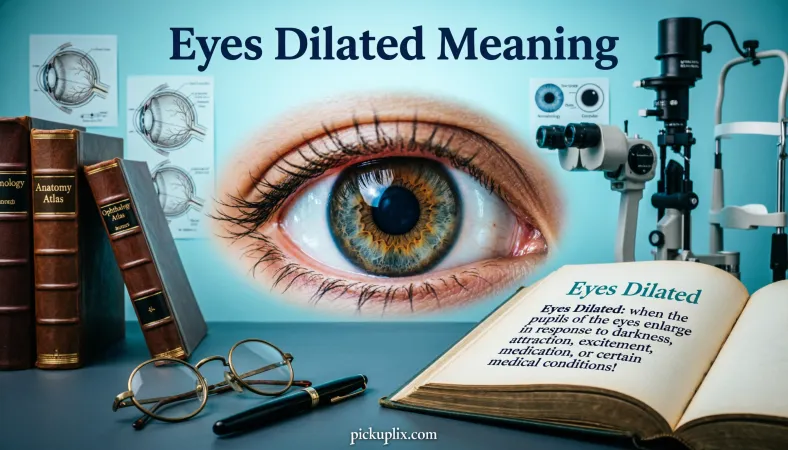
Eyes dilated means the pupils (the black centers of your eyes) become larger or wider than normal.
This can happen naturally in dim lighting, during strong emotions like excitement or fear, after using certain medications, or during an eye exam.
In some cases, dilated pupils may also indicate an underlying medical condition that requires attention.
What Does Eyes Dilated Mean?
Eyes dilated refers to enlarged pupils, the dark circular openings in the center of your eyes. The pupil controls how much light enters the eye. When it becomes larger, it allows more light to reach the retina, making it easier to see in darker environments.
The medical term for dilated pupils is mydriasis.
In everyday conversation, people may say someone’s “eyes are dilated” when their pupils appear noticeably bigger than usual.
Featured Snippet Answer
Eyes dilated means the pupils have expanded and become larger than normal. This is often a natural response to low light or strong emotions, but it can also occur because of medications, eye drops, or certain medical conditions.
Simple Example
- “Her eyes were dilated after the eye doctor used special drops.”
- “His pupils became dilated when the room suddenly went dark.”
In short: Eyes dilated = Enlarged pupils = More light enters the eye.
Why Do Eyes Dilate?
Your pupils are constantly changing size throughout the day. Tiny muscles inside the eye automatically control this process without you even noticing.
Here are the most common reasons why pupils dilate.
1. Low Light Conditions 🌙
The most common reason for dilated pupils is darkness.
When you walk into a dim room or go outside at night, your pupils naturally become larger to let in more light. This helps you see more clearly when visibility is low.
Example:
- Walking into a movie theater.
- Driving at night.
- Entering a dark room.
This is completely normal and happens to everyone.
2. Strong Emotions ❤️
Your emotions can also affect your pupil size.
When you experience excitement, surprise, fear, or intense happiness, your body’s nervous system responds by widening the pupils.
Common emotional triggers include:
- Falling in love
- Feeling excited
- Being surprised
- Experiencing fear
- Feeling nervous before an important event
Researchers have found that pupil size often increases during emotionally stimulating situations.
3. Certain Medications 💊
Some medications naturally cause pupil dilation as a side effect.
These may include:
| Medication Type | Why Pupils Dilate |
| Eye examination drops | Intentionally widen pupils for better eye exams |
| Some allergy medications | May affect pupil muscles |
| Certain antidepressants | Can influence the nervous system |
| Motion sickness medicines | Sometimes enlarge pupils |
| Some prescription medications | Side effect depending on the drug |
If your pupils become dilated after starting a new medication, check the medication information or speak with your healthcare provider if you’re concerned.
4. Eye Drops Used During an Eye Exam 👁️
One of the most familiar causes of dilated pupils is an eye examination.
Eye doctors often use special dilating drops before checking the retina and optic nerve. These drops temporarily make the pupils larger so they can clearly examine the inside of the eye.
After the exam, you may notice:
- Blurry vision
- Sensitivity to bright light
- Larger-than-normal pupils
These effects usually wear off within several hours, though they can sometimes last longer depending on the type of drops used.
5. Medical Conditions
Although dilated pupils are often harmless, they can occasionally be linked to an underlying health issue.
Possible medical causes include:
- Eye injuries
- Head trauma
- Migraine headaches
- Certain neurological conditions
- Rare nerve disorders
If one pupil suddenly becomes much larger than the other, or dilation occurs alongside severe headache, confusion, vision loss, or difficulty speaking, it should be evaluated by a medical professional immediately.
Eyes Dilated Meaning in Different Situations
The meaning of dilated pupils depends on the situation. In many cases, it’s a completely normal response. In others, it may simply reflect what’s happening in your body or environment.
In Low Light 🌙
This is the most common explanation.
When it’s dark, your pupils automatically widen to collect more light, helping you see more clearly.
Example:
Someone walks from a bright parking lot into a dark restaurant. Within seconds, their pupils become noticeably larger.
Meaning: A completely normal adjustment to darkness.
During Strong Emotions ❤️
Emotions can influence your nervous system, which in turn affects your pupils.
People often experience dilated pupils when they feel:
- Excited
- Amazed
- Nervous
- Happy
- Startled
This reaction is automatic and usually temporary.
When You’re Attracted to Someone 💕
You may have heard that dilated pupils can be a sign of attraction.
There is some scientific evidence showing that pupils can become larger when someone looks at a person they find attractive or emotionally engaging. However, this isn’t a reliable way to determine whether someone likes you because many other factors also affect pupil size.
For that reason, dilated pupils should never be interpreted as proof of romantic interest on their own.
During Fear or Stress 😨
When the body enters its natural fight-or-flight response, adrenaline is released.
This response prepares you to react quickly by increasing heart rate, sharpening focus, and often causing your pupils to widen.
For example:
- Hearing a sudden loud noise
- Nearly slipping on wet ground
- Feeling anxious before giving a speech
In these situations, pupil dilation is a normal physical response to stress.
After an Eye Examination 👨⚕️
If your pupils stay enlarged after visiting the eye doctor, there’s usually no need to worry.
Dilating eye drops are designed to keep the pupils open long enough for the doctor to examine the back of your eyes thoroughly.
You may notice:
- Larger pupils
- Bright lights seem uncomfortable
- Slightly blurry close-up vision
These effects are temporary and typically resolve as the medication wears off.
When to Use and When Not to Use “Eyes Dilated”
The phrase “eyes dilated” is best used when describing someone’s pupils becoming larger than normal. Depending on the situation, it can suggest excitement, attraction, fear, surprise, low lighting, or even a medical condition. Understanding the context helps you use the phrase correctly.
✅ When to Use “Eyes Dilated”
Use this expression when talking about:
- Someone feeling excited or amazed
- Her eyes dilated when she saw the surprise gift.
- Romantic attraction or admiration
- His eyes dilated the moment he looked at her.
- Fear or shock
- His eyes were dilated after hearing the loud explosion.
- Medical or health discussions
- The doctor said my eyes would stay dilated for a few hours after the exam.
- Storytelling or descriptive writing
- The detective noticed the suspect’s eyes were unusually dilated.
❌ When Not to Use “Eyes Dilated”
Avoid using it:
- In everyday casual chats when you simply mean someone is happy.
- As a replacement for emotions like “excited” or “surprised” without context.
- In professional emails where plain language is more appropriate.
- If you’re unsure whether the pupils actually became larger.
- As slang, because it isn’t a texting abbreviation or internet acronym.
Context Comparison Table
| Context | Example Phrase | Why It Works |
| Friend Chat | “his eyes were totally dilated when he saw the puppy 😂” | Casual and descriptive. |
| Romantic Conversation | “your eyes dilated when you looked at me ❤️” | Can suggest attraction or strong emotion. |
| Medical Appointment | “The drops will keep your eyes dilated for several hours.” | Accurate medical usage. |
| Story Writing | “Her eyes dilated as the door slowly opened.” | Creates suspense and vivid imagery. |
| Work Email | “He looked surprised.” | Simpler and more professional than describing pupil size. |
Similar Words and Alternatives
Depending on the context, these words and phrases can express a similar idea.
| Word or Phrase | Meaning | Best Used When |
| Wide-eyed | Looking amazed or surprised | Casual conversations and storytelling |
| Pupils enlarged | Medical way to describe dilated pupils | Healthcare and educational content |
| Astonished | Extremely surprised | Formal and informal writing |
| Mesmerized | Completely fascinated | Romantic or descriptive situations |
| Shocked | Suddenly surprised or frightened | Everyday conversations |
| Excited | Feeling happy or enthusiastic | General texting and social media |
FAQs About Eyes Dilated Meaning
What does “eyes dilated” mean?
It means the pupils become larger than normal. This can happen because of low light, strong emotions, attraction, fear, certain medications, or medical examinations.
Is “eyes dilated” a texting slang?
No. It isn’t a slang term or abbreviation. People simply use it as a descriptive phrase in texts and social media posts.
Can dilated eyes mean attraction?
Yes. When people are attracted to someone, their pupils may naturally become larger. However, attraction is only one possible reason for dilated pupils.
Why do doctors dilate your eyes?
Eye doctors use special drops to enlarge your pupils so they can clearly examine the retina, optic nerve, and other parts of the eye.
Can excitement cause your eyes to dilate?
Yes. Strong emotions like excitement, surprise, happiness, fear, or curiosity can temporarily cause your pupils to become larger.
Are dilated pupils always a medical problem?
No. Dilated pupils are often completely normal, especially in dim lighting or during emotional moments. However, sudden or persistent dilation with other symptoms should be checked by a healthcare professional.
How do you use “eyes dilated” in a sentence?
Here are a few examples:
- Her eyes dilated when she opened the birthday present.
- The patient’s eyes remained dilated after the examination.
- His eyes dilated with surprise as he heard the announcement.
What’s the difference between “eyes dilated” and “wide eyes”?
Eyes dilated specifically refers to larger pupils, while wide eyes usually describe the eyelids opening wider because of surprise, fear, or excitement. A person can have wide eyes without having noticeably dilated pupils.
Conclusion
The phrase “eyes dilated“ describes enlarged pupils, not a texting abbreviation or internet slang. It can reflect natural reactions to darkness, excitement, attraction, surprise, fear, or medical treatment. While it’s common in conversations, novels, and social media, its meaning depends heavily on context. Knowing how and when to use the phrase helps you understand messages more accurately and communicate more clearly.

Pickuplix Team creates fun, clever pickup lines for every mood and occasion, along with clear, accurate word and slang meaning guides. From flirty icebreakers to breaking down the latest texting slang, we’re here to help you communicate with confidence.