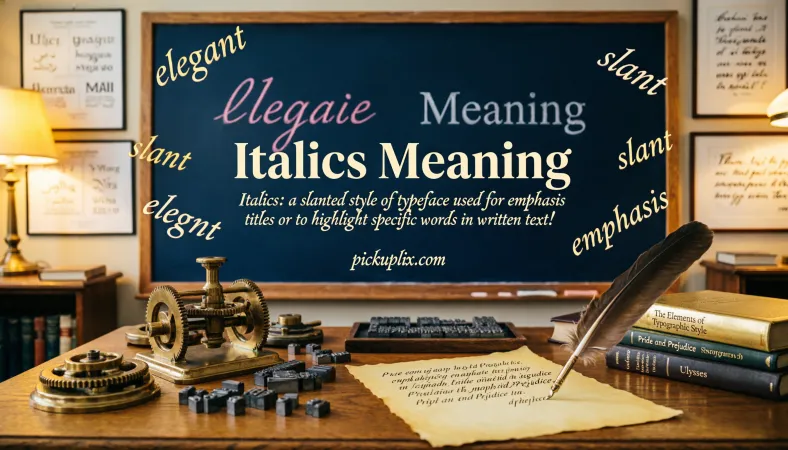
Have you ever been reading a social media post, a text message, or even an article and noticed that a few words looked slanted?
At first, it can be a little confusing. You might wonder if those words have a special meaning or if they’re trying to tell you something important.
Many people search for italic meaning because they see italicized words online but aren’t sure why they’re used or what message they convey.
Quick Answer: Italics are a text style where letters are slightly slanted to the right.
They’re commonly used to add emphasis, show titles of books or movies, indicate foreign words, or express a certain tone or emotion in writing. While italics aren’t a slang term, they play an important role in texting, social media, and online conversations by helping writers highlight specific words or feelings.
What Does Italics Mean in Text?
In text, italics refer to words or phrases displayed in a slanted font style. Writers use italics to make certain words stand out without using ALL CAPS or bold formatting.
For example:
I didn’t say you were wrong.
Here, italicizing I changes the emphasis of the sentence. It suggests that someone else may have said it, but not the speaker.
On platforms that don’t support italic formatting directly, people often create italics using Markdown by placing asterisks around a word, like:
*really*
which appears as:
really
In texting and online conversations, italics can express:
- Emphasis
- Sarcasm
- Internal thoughts
- Dramatic effect
- Emotional tone
Example:
A: Did you actually finish the project?
B: I finally finished it!
The italicized word shows extra emphasis.
In short: Italics = Slanted text = A way to emphasize words, express tone, or highlight important information.
Where Is Italics Commonly Used?
You’ll find italics almost everywhere online and in written communication.
📱 Social Media
- Instagram captions
- Facebook posts
- Threads
- Tumblr
- Medium articles
People use italics to stress important words or create a storytelling effect.
💬 Messaging Apps
- Discord
- Telegram
- WhatsApp (using formatting)
- Slack
Many messaging apps support italic formatting through Markdown or special symbols.
🎮 Gaming Chats
Gamers often use italics for:
- Roleplay actions
- Emphasis
- Character thoughts
Example:
opens the treasure chest
✍️ Blogs & Articles
Writers use italics for:
- Book titles
- Movie names
- Foreign phrases
- Scientific names
- Added emphasis
🎓 Academic Writing
Schools and universities use italics for:
- Research paper titles
- Journal names
- Species names
- Variables in mathematics
Tone
✅ Casual
✅ Creative
✅ Professional (when used correctly)
✅ Social-media friendly
Examples of Italics in Conversation
Example 1
A: Did you really buy that?
B: i had to 😂
Example 2
A: Who’s coming tonight?
B: Everyone is!
Example 3
A: Are you mad?
B: i’m fine 😅
Example 4
A: Was the movie good?
B: it was amazing 🍿
Example 5
A: Did she actually say that?
B: exactly those words 😭
Example 6
A: I’m tired.
B: you need sleep 😴
Example 7
A: Should I text them?
B: Absolutely! ❤️
When to Use and When Not to Use Italics
✅ When to Use
Use italics when you want to:
- Add emphasis
- Express emotion
- Highlight an important word
- Show internal thoughts
- Mention book or movie titles
- Write foreign phrases
- Make online posts more expressive
❌ When Not to Use
Avoid italics when:
- Writing legal documents
- Creating emergency messages
- Sending official business emails without reason
- Over-formatting every sentence
- Using accessibility-first documents where excessive formatting can reduce readability
Comparison Table
| Context | Example Phrase | Why It Works |
| Friend Chat | “Seriously, that’s hilarious 😂” | Adds playful emphasis |
| Social Media | “Best vacation ever!” | Highlights excitement |
| Work Chat | “Please review the attached report.” | Plain text is clearer |
| “Please take your time reviewing the proposal.” | Professional and formal | |
| Blog Article | “Harry Potter is my favorite book.” | Correct style for book titles |
Similar Text Styles or Alternatives
| Style | Meaning | When to Use |
| Bold | Strong emphasis | Headlines, important points |
| ALL CAPS | Very strong emphasis | Warnings or excitement (sparingly) |
| Underline | Highlights text | Educational material |
| Quotes (“”) | Indicates speech or titles | Dialogue or article names |
| Emoji 😊 | Adds emotion | Casual conversations |
| Ellipsis (…) | Creates suspense | Informal texting |
FAQs About Italics
What do italics mean in texting?
They usually add emphasis or emotion to a specific word, making it stand out from the rest of the sentence.
Are italics considered slang?
No. Italics are a writing style, not a slang word or abbreviation.
Can I use italics on WhatsApp?
Yes. On WhatsApp, place an underscore before and after a word, like _hello_, to display it in italics.
Why do people use italics on social media?
They help emphasize important words, create dramatic effects, and make posts easier to read.
Are italics professional?
Yes. They’re widely accepted in books, articles, academic writing, and professional documents when used correctly.
What’s the difference between bold and italics?
Bold makes text visually stronger, while italics add subtle emphasis or indicate titles, thoughts, or special terms.
Do italics change the meaning of a sentence?
Sometimes. Emphasizing different words with italics can subtly change the focus or interpretation of the sentence.
Final Thoughts
Understanding the italics meaning is useful whether you’re reading a blog, chatting with friends, or creating content online. Rather than being a slang term, italics are a formatting style that helps writers emphasize ideas, express emotion, highlight titles, or improve readability. When used thoughtfully, italic text can make your message clearer, more engaging, and more expressive without overwhelming the reader. Whether you’re posting on social media or writing professionally, knowing when and how to use italics is a valuable writing skill.
Pickuplix Team creates fun, clever pickup lines for every mood and occasion, along with clear, accurate word and slang meaning guides. From flirty icebreakers to breaking down the latest texting slang, we’re here to help you communicate with confidence.