
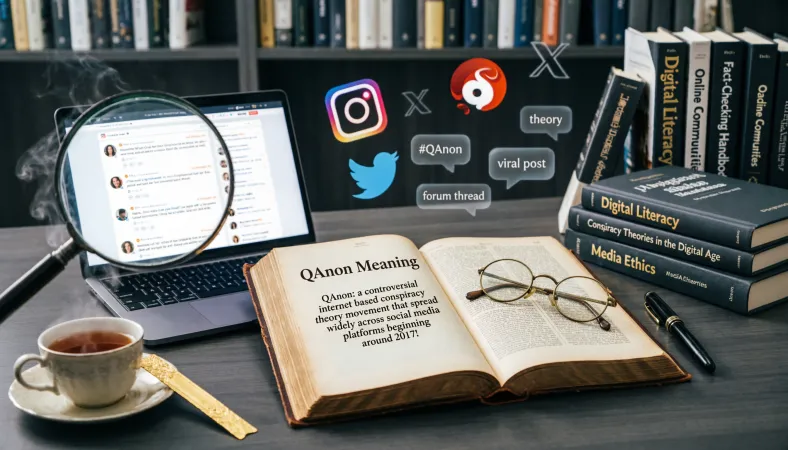
If you’ve been reading news articles, scrolling through social media, or watching political discussions online, you’ve probably come across the term QAnon.
At first glance, it can seem confusing because it’s often mentioned without much explanation.
Many people wonder whether it’s a political group, an online community, or simply another internet trend.
The truth is that QAnon is not a texting abbreviation or internet slang. Instead, it refers to a conspiracy movement that began online and later gained attention around the world.
Understanding what the term means can help you better understand news reports and online discussions.
Quick Answer:
QAnon is the name of a conspiracy movement that began with anonymous online posts from a person calling themselves “Q.”
Followers believed these posts revealed secret information about politics and world events, although many of the claims have been widely discredited.
What Does QAnon Mean?
QAnon combines two parts:
- Q refers to an anonymous individual who claimed to have high-level U.S. government security clearance, often described online as “Q clearance.”
- Anon is short for anonymous, a term commonly used on internet message boards where users post without revealing their identities.
Together, QAnon refers to the online movement built around interpreting and discussing messages posted by this anonymous figure.
Featured Snippet Answer
QAnon is an online conspiracy movement centered around anonymous posts written by someone known as “Q.” Followers believed the posts contained hidden information about politics, government, and world events, though these claims have been widely rejected by experts and supported by no credible evidence.
Simple Example
“The documentary explained how QAnon became widely discussed on social media during recent political events.”
In this sentence, QAnon refers to the movement itself rather than a person or organization.
Pallbearers Meaning: Role, Duties & Funeral Etiquette Explained
Where Did the Term QAnon Come From?
QAnon first appeared in October 2017 on anonymous online message boards.
A user calling themselves Q began posting messages that claimed to reveal classified information about secret government operations and political events. These posts quickly attracted online communities that attempted to decode the messages and predict future events.
Over time, discussions spread to larger social media platforms, video-sharing websites, blogs, and online forums. As media coverage increased, the term QAnon became widely recognized around the world.
Although many followers believed Q’s posts contained hidden truths, numerous investigations and fact-checking organizations have found no credible evidence supporting the movement’s major claims.
What Do QAnon Supporters Believe?
While beliefs vary among individuals, many followers have shared several common ideas.
Some supporters believe:
- Secret groups control major political and financial institutions.
- Anonymous messages from “Q” reveal hidden information.
- Certain public events contain secret meanings.
- Followers can uncover hidden truths by interpreting Q’s posts.
It is important to understand that these beliefs are claims made within the movement and are not supported by reliable evidence. Researchers, journalists, and government agencies have repeatedly found no factual basis for many of QAnon’s central assertions.
Because beliefs differ from person to person, not every supporter accepts every claim associated with the movement.
Why Is QAnon Controversial?
QAnon has received significant attention because many of its claims have been challenged or disproven by credible reporting, independent investigations, and fact-checking organizations.
The movement has also raised concerns because:
- Many claims lack verifiable evidence.
- False information has spread widely through social media.
- Some predictions made by the movement never occurred.
- Public officials and researchers have warned about misinformation connected to conspiracy theories.
For these reasons, QAnon remains a controversial topic discussed in politics, media, technology, and online safety.
How Is the Word QAnon Used Today?
Today, the word QAnon is most commonly used in:
- 📰 News articles discussing politics, misinformation, or online communities.
- 🎙️ Podcasts covering current events or internet culture.
- 📺 Documentaries exploring conspiracy theories and their impact.
- 💻 Social media discussions where people debate or reference the movement.
- 📚 Academic research about misinformation, digital communities, and political communication.
Unlike internet abbreviations such as “LOL” or “BRB,” QAnon is not a texting slang term. It is the name of a specific movement, so it is generally written with a capital Q and A.
Is It Formal or Casual?
| Platform | How It’s Used |
| News websites | Formal |
| Research papers | Formal |
| Political discussions | Formal |
| Social media | Casual to formal depending on context |
| Text messages | Occasionally mentioned, but not used as slang |
Real-Life Example Sentences
Here are some natural examples of how the term QAnon appears in everyday writing and conversations.
Example 1
A: “Did you watch that documentary last night?”
B: “Yes, it explained how QAnon became popular online.”
Example 2
A: “Why is everyone talking about QAnon?”
B: “It’s a conspiracy movement that started on internet forums.”
Example 3
“The professor discussed how QAnon spread through social media platforms.”
Example 4
“The article examined the influence of QAnon on online communities.”
Example 5
“I didn’t know what QAnon meant until I read a news report explaining its history.”
Common Terms Related to QAnon
Understanding these related terms can make articles and discussions easier to follow.
| Term | Meaning |
| Conspiracy theory | A belief that secret groups are behind important events without credible supporting evidence. |
| Anonymous | A person whose identity is unknown. |
| Internet forum | A website where users discuss topics and share posts. |
| Misinformation | False or inaccurate information shared without reliable evidence. |
| Online community | A group of people interacting through websites or social media. |
| Fact-checking | Verifying whether public claims are supported by credible evidence. |
Frequently Asked Questions
What does QAnon stand for?
QAnon combines “Q,” the anonymous online poster, and “Anon,” meaning anonymous. Together, the name refers to the conspiracy movement that formed around Q’s online posts.
Is QAnon a slang word?
No. QAnon is not texting slang or an internet abbreviation. It is the name of a conspiracy movement discussed in news reports, documentaries, and political conversations.
Where did QAnon begin?
The movement began in 2017 on anonymous online message boards, where someone calling themselves Q started posting messages claiming to reveal secret government information.
Is QAnon still discussed today?
Yes. Although online activity has changed over time, the term still appears in news coverage, academic research, documentaries, and discussions about misinformation and internet culture.
Why is QAnon controversial?
QAnon is controversial because many of its central claims have been investigated and found to lack credible supporting evidence. Researchers, journalists, and public institutions frequently cite it as an example of how misinformation can spread online.
Is QAnon a political party?
No. QAnon is not a political party. It is generally described as an online conspiracy movement rather than an official political organization.
Conclusion
Understanding the QAnon meaning helps you make sense of many political and social discussions online. Rather than being a texting abbreviation or social media slang, QAnon refers to a conspiracy movement that began with anonymous internet posts from someone identifying as Q.
Today, the term mainly appears in news reports, documentaries, research, and discussions about misinformation, online communities, and modern politics. Knowing its origin and context allows readers to better understand articles and conversations where the term is mentioned.

Mark Twain is a writer at Pickuplix.com, creating witty and fun pickup lines to help readers flirt with confidence and make people laugh.