A friend texts “that’s so his mo” after describing something someone always does, or maybe you’ve seen “hang on a mo” pop up in a British sitcom, and either way, those two little letters can mean surprisingly different things depending on where you encounter them.
Unlike a lot of trendy internet slang that fades quickly, MO has a genuinely interesting backstory rooted in something far older than texting.
Quick Answer:
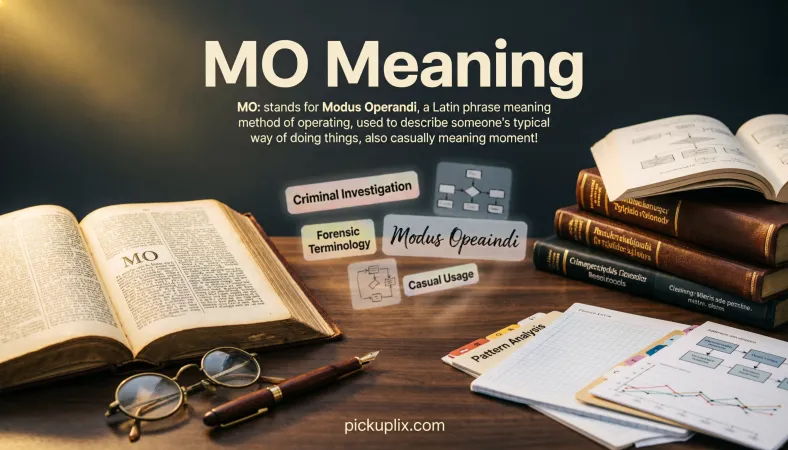
MO most commonly means “Modus Operandi,” a Latin phrase meaning “method of operating,” used to describe someone’s typical way of doing things. It can also casually mean “moment,” as in “hang on a mo.”
What Does MO Mean in Text?
MO has two genuinely common meanings depending on context:
1. Modus Operandi — This is the most established and widely recognized meaning, referring to someone’s characteristic method, behavior pattern, or typical way of doing something. It’s used both formally (in law enforcement and criminology) and casually in everyday conversation to describe personal habits or patterns.
2. Moment — A casual, mostly British shorthand for “moment,” commonly used in phrases like “hang on a mo” or “just a mo,” meaning a brief pause or short wait.
Example Sentence: He always shows up fifteen minutes late, that’s just his mo at this point.
In short: MO = Modus Operandi (method/pattern of behavior) or Moment (a short pause), depending on context.
Where Does MO Come From?
“Modus Operandi” is a Latin phrase that has been used in English since the mid-1800s, originally adopted in legal and law enforcement contexts to describe a criminal’s consistent method of committing crimes. Detective fiction and crime dramas helped popularize the abbreviation “MO,” with characters frequently referencing a suspect’s “MO” when identifying patterns in criminal behavior.
Over time, the term expanded beyond strictly criminal contexts into everyday language, now casually used to describe anyone’s typical habits, whether that’s always running late, ghosting after a few dates, or having a particular way of handling stress.
The “moment” meaning of MO developed separately and much more informally, as a natural shortening common in casual British English speech, later spreading into texting culture more broadly.
Where Is “MO” Commonly Used?
- 🚔 Law enforcement and true crime content — Referring to Modus Operandi in criminal behavior
- 💬 Everyday texting and conversation — Describing someone’s typical habits or behavior pattern
- 🇬🇧 British casual speech — Using “mo” to mean a brief moment
- 💕 Dating and relationship conversations — Describing someone’s typical relationship behavior or patterns
This term works in both formal and casual contexts, making it fairly versatile depending on the situation.
Examples of MO in Conversation
A: he never texts back right away, then apologizes days later B: yeah that’s definitely his mo, happens every time
A: why does she always cancel plans last minute B: honestly that’s just her mo, kind of expected it
A: can you help me with this in a sec B: yeah gimme a mo, finishing something up
A: he ghosted again after three dates B: classic mo for him unfortunately
A: the detective said the crime matched a known suspect’s pattern B: yeah, sounds like it fits his usual mo
When to Use and When Not to Use “MO”
✅ When to Use:
- Describing someone’s consistent behavior pattern casually
- Referring to a criminal’s method in true crime or legal discussions
- Using “mo” casually to mean a brief pause, especially in British English
❌ When Not to Use:
- In formal writing without context, since it can be ambiguous
- Serious legal documentation, where “modus operandi” should be spelled out fully
| Context | Example Phrase | Why It Works |
| Friend Chat | “That’s so his mo lol” | Casual and relatable |
| True Crime Content | “It matches the suspect’s known MO.” | Clear, established usage |
| British Casual Speech | “Hang on a mo, be right there.” | Natural, informal shorthand |
Similar Words or Alternatives
| Term | Meaning | When to Use |
| Pattern | A general term for consistent behavior | Everyday, neutral description |
| Habit | A repeated behavior or tendency | Casual conversation |
| Signature move | A person’s typical, identifiable action | Playful or casual description |
| Just a sec | Casual alternative to “mo” meaning moment | Everyday texting |
| Method | Formal alternative to Modus Operandi | Professional or technical writing |
MO in Dating and Relationships
One area where “MO” has become especially popular in casual conversation is dating culture, where it’s used to describe a person’s typical patterns in relationships. This might include things like how someone tends to communicate, how quickly they move in a relationship, or recurring behaviors friends notice across multiple dating experiences.
- “His mo is always love-bombing early on” — describing a common relationship pattern
- “That’s her mo, she always goes quiet after an argument” — describing communication habits
- “Ghosting is unfortunately his mo” — describing a recurring negative pattern
This usage keeps the core meaning, someone’s consistent method or pattern, while applying it to the very modern context of dating and relationship dynamics.
FAQs About MO Meaning
What does MO mean in texting?
MO most commonly means “Modus Operandi,” describing someone’s typical behavior pattern or method of doing things, though it can also casually mean “moment.”
Is MO always related to crime?
No, while it originated in law enforcement and criminology, MO is now widely used casually to describe anyone’s typical habits or behavior, unrelated to criminal activity.
What does “hang on a mo” mean?
It means “wait a moment,” a casual, mostly British shorthand used when asking someone to wait briefly.
Is MO formal or casual?
It’s flexible, used formally in legal and law enforcement contexts as “Modus Operandi,” and casually in everyday texting to describe personal habits or patterns.
Can MO be used to describe positive behavior?
Yes, it’s not limited to negative habits, MO can describe any consistent behavior pattern, whether that’s always being early, generous, or predictable in a good way.
Is MO the same as “more” in texting?
Not typically in established usage, though some casual or regional texting shorthand may use “mo” loosely for “more,” it’s far less standardized than its Modus Operandi meaning.
Conclusion
Understanding MO reveals a genuinely interesting linguistic journey, from a formal Latin legal term to a casual way of describing anyone’s typical habits or quirks. Whether you’re discussing a true crime documentary or just teasing a friend about their predictable behavior, MO carries a surprising amount of history behind those two simple letters. Now that you know its real meaning and origin, you’ll probably start noticing it used a lot more often than you realized.

Pickuplix Team creates fun, clever pickup lines for every mood and occasion, along with clear, accurate word and slang meaning guides. From flirty icebreakers to breaking down the latest texting slang, we’re here to help you communicate with confidence.