You’re wrapping up a conversation with a friend who studied French, or maybe you saw it as a sign-off on someone’s Instagram story, and there it is, “à bientôt,” sitting at the end of the message looking effortlessly chic.
If you weren’t quite sure how to say it or what it actually meant, you’re definitely not alone, this little French phrase shows up more often than people expect in everyday English conversations.
Quick Answer:
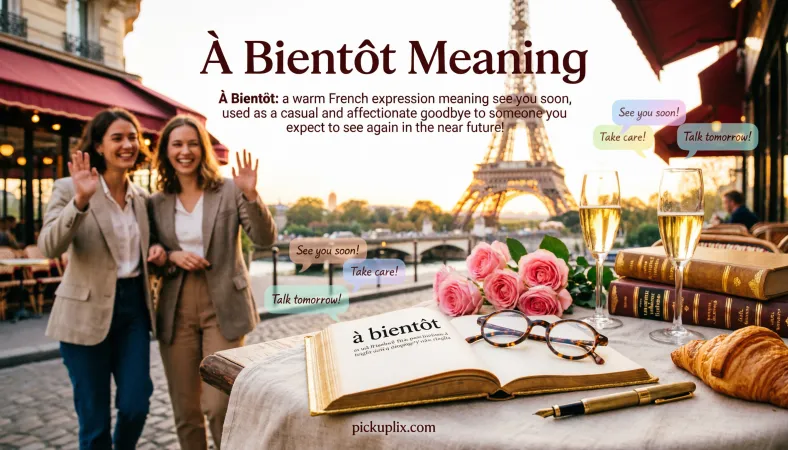
À bientôt means “see you soon” in French.
It’s a warm, casual way of saying goodbye to someone you expect to see again in the near future, and it’s increasingly used in English texting and social media too.
What does À Bientôt mean?
À bientôt is a French phrase that literally translates to “see you soon.” It’s made up of two parts: “à,” meaning “to” or “at,” and “bientôt,” meaning “soon.” Together, they form a friendly, natural way to say goodbye when you expect to reconnect with someone relatively soon, whether that’s later that day, the next day, or sometime in the near future.
It’s pronounced “ah byan-toh” (IPA: /a bjɛ̃.to/), with a soft nasal sound on “bien” rather than a hard “n.”
Example Sentence: I have to head out now, à bientôt, let’s catch up again soon!
In short: À Bientôt = See You Soon = A Warm, Casual Goodbye.
QAnon Meaning: Definition, Origin, Beliefs & Why It’s Controversial
Where Does À Bientôt Come From?
À bientôt comes directly from French, where it’s one of the most commonly used everyday goodbyes, right alongside phrases like “au revoir.” It has been part of the French language for centuries, forming naturally from the words “à” (to/at) and “bientôt” (soon), both of which trace back to Old French and Latin roots.
Unlike many trendy internet phrases, à bientôt isn’t new slang, it’s simply a well-established French expression that has gradually made its way into English usage, especially among people who enjoy French culture, language learners, or those who simply like the phrase’s elegant sound.
Pallbearers Meaning: Role, Duties & Funeral Etiquette Explained
Where Is À Bientôt Commonly Used?
- 🇫🇷 French conversation — A standard, everyday way to say goodbye when expecting to reconnect soon
- 📱 Social media captions and sign-offs — Popular for adding a chic, worldly touch to a post or story
- 💬 English texting among French learners or francophiles — Used casually as a stylish alternative to “see you soon”
- ✍️ Formal and informal writing alike — Appropriate in both casual notes and slightly more polished correspondence
This phrase works in both casual and semi-formal contexts, making it more versatile than many English slang terms.
Examples of À Bientôt in Use
- I really enjoyed catching up today, à bientôt, let’s do this again soon.
- She ended her email with a simple “à bientôt” instead of the usual “talk soon.”
- We said our goodbyes at the airport with a quick hug and an “à bientôt.”
- His Instagram caption just said “à bientôt, Paris,” hinting at a future trip back.
- After the meeting wrapped up, she smiled and said, “à bientôt, until next time.”
When to Use and When Not to Use À Bientôt
✅ When to Use:
- Saying goodbye to someone you expect to see again soon
- Adding a stylish, French-inspired touch to a text or caption
- Casual or semi-formal farewells, both spoken and written
❌ When Not to Use:
- When you genuinely don’t know if or when you’ll see the person again (a phrase like “au revoir” fits better)
- In very formal business correspondence where full English phrasing may be expected
- If the audience is unfamiliar with French and clarity is more important than style
| Context | Example Phrase | Why It Works |
| Friend Chat | “Had so much fun today, à bientôt! 😊” | Casual and charming |
| Work Chat | “Talk again soon, take care.” | Professional but still warm |
| Formal Email | “I look forward to our next conversation.” | Fully formal and clear |
Similar Words or Alternatives
| Phrase | Meaning | When to Use |
| Au revoir | Formal French goodbye | General farewells, less specific timing |
| See you soon | English equivalent | Everyday casual goodbyes |
| Ciao | Informal Italian goodbye | Casual, similar chic sign-off |
| Talk soon | Casual English alternative | Texting and informal messages |
| À plus tard | “See you later” in French | Similar casual French farewell |
Other French Goodbye Phrases Worth Knowing
À bientôt is part of a whole family of French farewells, each with slightly different timing and tone.
- À plus tard — “See you later,” used for the same day or very soon
- À demain — “See you tomorrow,” specific to the next day
- À la prochaine — “Until next time,” a bit more casual and open-ended
- Au revoir — The standard, general “goodbye,” without implying a specific timeframe
Learning a few of these alongside à bientôt gives you a versatile little toolkit of French farewells, each suited to slightly different situations depending on how soon you expect to reconnect.
FAQs About À Bientôt Meaning
What does à bientôt mean?
À bientôt means “see you soon” in French, used as a warm, casual goodbye when you expect to see the person again in the near future.
How do you pronounce à bientôt?
It’s pronounced “ah byan-toh,” with a soft nasal sound on “bien,” similar to the sound in the French word for bread, “pain.”
Is à bientôt formal or casual?
It works in both contexts, making it more flexible than many other French farewells, appropriate for everyday chats as well as lightly formal writing.
What’s the difference between à bientôt and au revoir?
À bientôt implies you’ll see the person again soon, while au revoir is a more general goodbye that doesn’t specify timing, similar to a standard “goodbye” in English.
Can I use à bientôt if I don’t speak French?
Yes, it’s commonly used by English speakers as a stylish alternative to “see you soon,” even without fluency in French.
Is à bientôt commonly used on social media?
Yes, it’s a popular sign-off in captions and stories, especially among people who enjoy French culture or want to add a chic, worldly touch to their posts.
Conclusion
À bientôt is more than just a trendy phrase, it’s a genuine piece of everyday French that has found a comfortable place in English conversations and social media alike. Meaning simply “see you soon,” it offers a warm, stylish way to say goodbye when you know you’ll be reconnecting again before too long. Whether you’re a French learner, a francophile, or just someone who appreciates a charming sign-off, now you know exactly what it means and how to use it with confidence.

Agatha Christie is a writer at Pickuplix.com, known for creating fun, clever, and confidence boosting pickup lines. She focuses on playful humor and relatable flirting that feels natural and easy. Her goal is to help readers spark conversations with a smile.