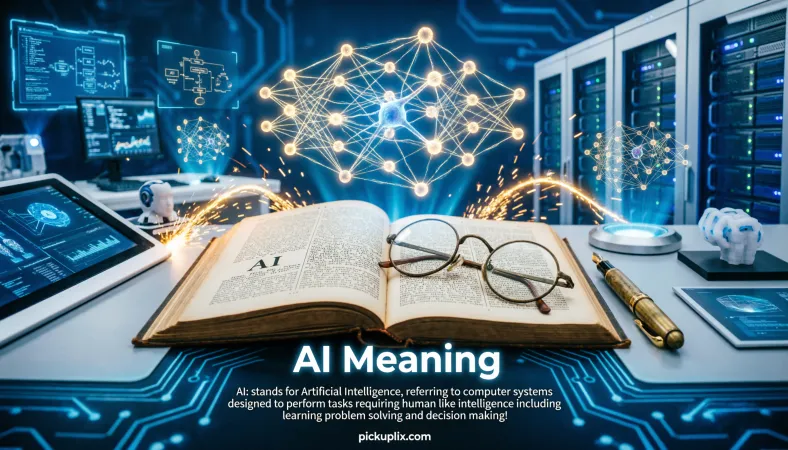
You ask your phone a question and it answers instantly, your streaming app somehow knows exactly what you want to watch next, and every other headline seems to mention it, AI.
It’s one of those terms that gets used constantly, in casual conversation, in the news, and in everyday apps, yet a lot of people have never actually looked up what it fully means or where the term came from.
Quick Answer:
AI means “Artificial Intelligence,” referring to computer systems designed to perform tasks that typically require human intelligence, such as learning, reasoning, problem-solving, and understanding language.
What Does AI Mean?
AI stands for Artificial Intelligence, a broad field of computer science focused on building machines and software capable of performing tasks that would normally require human thinking. This includes things like recognizing speech, understanding language, making decisions, solving problems, and learning from data over time.
AI isn’t a single technology, it’s an umbrella term covering many different approaches, including machine learning, natural language processing, computer vision, and more specialized systems designed for specific tasks.
Example Sentence: The customer service chatbot uses AI to understand questions and provide helpful answers automatically.
In short: AI = Artificial Intelligence = Machines Performing Human-Like Thinking Tasks.
Where Does the Term AI Come From?
The term “Artificial Intelligence” was coined in 1956 by computer scientist John McCarthy, who used it while organizing the Dartmouth Conference, widely considered the founding event of AI as a formal academic field. McCarthy and his colleagues wanted a term that captured the goal of creating machines capable of intelligent behavior, distinct from simple automation or mechanical calculation.
Since then, the field has evolved dramatically, from early rule-based systems in the mid-20th century to today’s machine learning and deep learning models capable of generating text, images, and complex predictions based on massive amounts of data.
Where Is “AI” Commonly Used?
- 💻 Everyday technology — Virtual assistants, recommendation systems, and smart apps
- 📱 Social media and content platforms — Personalized feeds and content suggestions
- 🏢 Business and industry — Automation, data analysis, and customer service tools
- 🎓 Academic and scientific research — A major field of study within computer science
- 🗣️ Everyday conversation — Frequently used casually to describe smart or automated technology
AI is used in both highly technical contexts and casual, everyday conversation, making it one of the most versatile terms in modern language.
Examples of AI in Use
- The company implemented AI to help analyze customer feedback more efficiently.
- Many smartphones now use AI to improve photo quality automatically.
- Researchers are studying how AI can assist in early disease detection.
- I’ve been using an AI tool to help organize my writing and ideas.
- Self-driving cars rely heavily on AI to interpret their surroundings in real time.
When to Use and When Not to Use “AI”
✅ When to Use:
- Describing technology that mimics human reasoning or learning
- Discussing automation, data analysis, or smart systems
- Casual or technical conversations about modern software and tools
❌ When Not to Use:
- Describing simple automation that doesn’t involve learning or adaptive behavior (this is more accurately just “automation”)
- Overusing the term for basic technology that isn’t genuinely AI-driven, which can create confusion
| Context | Example Phrase | Why It Works |
| Everyday Use | “This app uses AI to recommend shows.” | Clear and accurate |
| Technical Writing | “The model was trained using a large dataset.” | Precise, technical context |
| Casual Conversation | “AI is getting really advanced lately.” | Natural, conversational tone |
Similar Words or Related Terms
| Term | Meaning | When to Use |
| Machine Learning (ML) | A subset of AI focused on learning from data | Technical discussions about AI methods |
| Automation | Technology performing tasks without human input, not always “intelligent” | General tech discussions |
| Deep Learning | An advanced ML technique using neural networks | Technical or research contexts |
| Algorithm | A set of rules or steps a computer follows | Broader technical conversations |
| Chatbot | An AI-powered conversational tool | Everyday or customer service contexts |
Different Types of AI Worth Knowing
Not all AI works the same way, and understanding a few key categories helps clarify how the term is actually used.
- Narrow AI — Designed for a specific task, like voice recognition or recommendation systems; this is the most common type in use today
- General AI — A theoretical form of AI with human-level reasoning across many tasks, which doesn’t fully exist yet
- Machine Learning — Systems that improve their performance by learning patterns from data rather than following fixed rules
- Generative AI — A newer category capable of creating text, images, or other content based on learned patterns
Most AI people interact with daily, from chatbots to recommendation algorithms, falls under narrow AI, even though it often feels remarkably advanced.
FAQs About AI Meaning
What does AI mean?
AI means “Artificial Intelligence,” referring to computer systems designed to perform tasks that typically require human intelligence, like learning, reasoning, and problem-solving.
Who coined the term “Artificial Intelligence”?
The term was coined by computer scientist John McCarthy in 1956, during the organization of the Dartmouth Conference, considered the founding event of AI as an academic field.
Is AI the same as machine learning?
Not exactly. Machine learning is a subset of AI, one specific approach among several used to build intelligent systems, while AI is the broader overall field.
Is AI a new technology?
While recent advancements have made AI far more powerful and visible, the field itself dates back to the 1950s, with decades of research building up to today’s capabilities.
Can AI think like a human?
Not exactly. AI can perform specific tasks that resemble human reasoning, but it doesn’t have consciousness, emotions, or genuine understanding the way humans do.
Is AI used in everyday apps people don’t realize?
Yes, many everyday tools, like spam filters, recommendation systems, and voice assistants, run on AI without most users even realizing it’s involved.
Conclusion
Understanding what AI truly means helps make sense of just how deeply this technology has woven itself into everyday life, often without people even noticing. From its formal beginnings in 1956 to the advanced systems used today, Artificial Intelligence continues to evolve rapidly, shaping everything from casual apps to major scientific research. Knowing the real definition behind the term makes it a lot easier to understand the technology shaping so much of the modern world.
Pickuplix Team creates fun, clever pickup lines for every mood and occasion, along with clear, accurate word and slang meaning guides. From flirty icebreakers to breaking down the latest texting slang, we’re here to help you communicate with confidence.