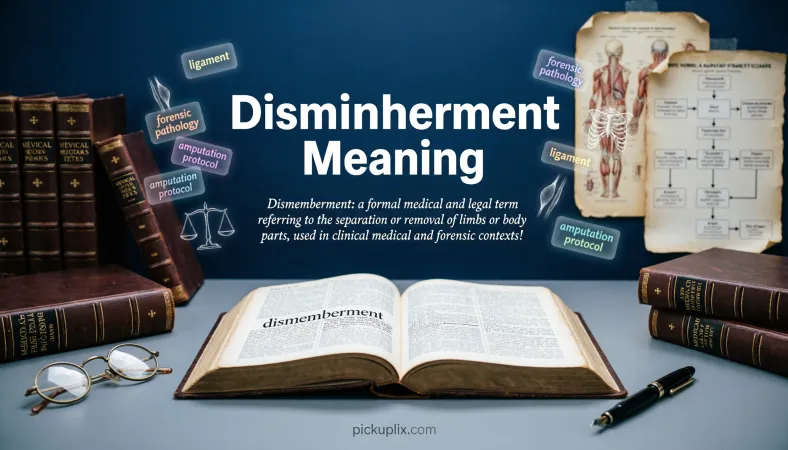
Dismemberment is a formal, serious term that appears most often in legal, medical, and historical contexts rather than everyday conversation.
Because it describes a severe and often distressing subject, understanding its precise meaning and appropriate usage is more useful than encountering it without context, such as in a news report, legal document, or historical account.
Quick Answer:
Dismemberment means the act of removing or severing limbs or body parts from a body. It is a formal, clinical, or legal term, not casual or conversational language.
What Does Dismemberment Mean?
Dismemberment refers to the separation of limbs or body parts from a body, whether through violent action, surgical necessity, accident, or historical practice. The term is used in several distinct contexts:
- Legal and criminal contexts — Referenced in criminal law, particularly in cases involving violent crime
- Medical contexts — Occasionally used in historical or clinical discussions of amputation, though “amputation” is the standard modern medical term
- Historical contexts — Referenced in discussions of historical punishments or practices
- Insurance terminology — Appears in some insurance policies under “Accidental Death and Dismemberment” (AD&D) coverage, referring to the loss of a limb due to an accident
In short: Dismemberment = Separation of Body Parts = A Formal, Clinical, or Legal Term.
Where Is “Dismemberment” Commonly Used?
- ⚖️ Legal and criminal justice contexts — Court documents, criminal law discussions, and news reporting on legal cases
- 🏥 Insurance policies — Specifically within “Accidental Death and Dismemberment” (AD&D) insurance terminology
- 📚 Historical and academic writing — Discussions of historical events or practices
- 📰 News reporting — Used factually and carefully when covering serious criminal cases
This term is formal and serious in nature. It is not used casually in everyday conversation, texting, or social media.
Understanding “Accidental Death and Dismemberment” (AD&D) Insurance
One of the most practical, everyday contexts where this term appears is in insurance policies. AD&D insurance provides financial compensation if a policyholder dies or loses a limb, sight, or other specified bodily function due to a covered accident. This is a standard part of many life and supplemental insurance policies, and the term “dismemberment” here refers specifically to accidental loss of a limb, not violence.
Example Sentence: Her employer’s benefits package included Accidental Death and Dismemberment insurance as part of the standard coverage.
Scorned Meaning in Text: Definition, Examples & When to Use It
When Is This Term Appropriate to Use?
✅ Appropriate contexts:
- Legal, medical, or insurance documentation
- Factual news reporting on legal proceedings
- Academic or historical research and writing
❌ Not appropriate for:
- Casual conversation, texting, or social media captions
- Humorous, playful, or lighthearted content
- Any context unrelated to its formal legal, medical, or insurance usage
| Context | Example Phrase | Why It Works |
| Insurance Documentation | “The policy includes Accidental Death and Dismemberment coverage.” | Accurate, formal terminology |
| Legal Reporting | “The court case involved charges related to the incident.” | Neutral, factual language |
| Academic Writing | “Historical records describe this practice as a form of punishment.” | Appropriate scholarly context |
Related Terms
| Term | Meaning | Context |
| Amputation | Surgical removal of a limb, typically for medical reasons | Medical and clinical contexts |
| AD&D Insurance | Accidental Death and Dismemberment insurance coverage | Insurance and benefits documentation |
| Mutilation | Severe damage or disfigurement of the body | Legal and medical contexts |
| Homicide | The killing of one person by another | Legal and criminal justice contexts |
FAQs About Dismemberment Meaning
What does dismemberment mean?
Dismemberment means the separation or removal of limbs or body parts from a body. It is a formal term used in legal, medical, insurance, and historical contexts.
What is Accidental Death and Dismemberment (AD&D) insurance?
AD&D insurance is a type of coverage that provides financial compensation if a policyholder dies or loses a limb, sight, or another specified bodily function due to a covered accident.
Is dismemberment the same as amputation?
They’re related but not identical. Amputation typically refers to a planned surgical procedure, while dismemberment is a broader term that can describe accidental, violent, or historical contexts.
Is this term appropriate for casual conversation?
No, it’s a formal, serious term reserved for legal, medical, insurance, or academic contexts, not everyday or casual conversation.
Where might someone encounter this term in daily life?
The most common everyday encounter is through insurance paperwork, specifically Accidental Death and Dismemberment policies included in many employee benefits packages.
Conclusion
Understanding the accurate meaning of “dismemberment” is useful primarily in formal contexts, particularly when reviewing insurance documentation, legal reporting, or academic material. While the term describes a serious and sensitive subject, knowing its precise definition and appropriate use helps ensure clarity when it appears in professional or informational writing.

Pickuplix Team creates fun, clever pickup lines for every mood and occasion, along with clear, accurate word and slang meaning guides. From flirty icebreakers to breaking down the latest texting slang, we’re here to help you communicate with confidence.