If you’ve ever read the opening lines of Romeo and Juliet, you’ve probably come across the phrase “fatal loins” and paused, wondering what Shakespeare actually meant by it.
It sounds dramatic, a little strange, and definitely not like everyday English, which is exactly why so many students search for its meaning while studying the play.
Understanding this phrase isn’t just about knowing a dictionary definition, it’s about understanding how Shakespeare packed an entire story’s fate into just two words.
Quick Answer:
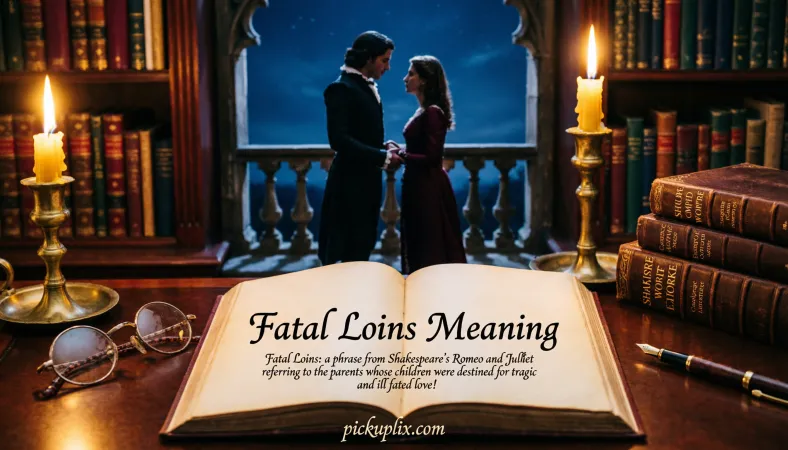
“Fatal loins” is a phrase from the Prologue of Romeo and Juliet, meaning the family lineage or birth origin of the two lovers is marked by tragedy and doom.
“Loins” refers to the body’s reproductive region, symbolizing birth and family line, while “fatal” means fated for tragedy or death.
What Does “Fatal Loins” Mean?
The phrase comes from the very first lines of Romeo and Juliet’s Prologue:
“From the fatal loins of these two foes, a pair of star-cross’d lovers take their lives.”
To understand it, it helps to break the phrase into its two parts.
Loins refers to the lower part of the body associated with reproduction and birth. In Shakespeare’s time, saying someone came “from the loins” of their parents simply meant they were born from that family line.
Fatal in Shakespeare’s usage doesn’t only mean “deadly.” It also means something is fated, destined, or headed toward tragedy because of forces beyond anyone’s control.
Put together, “fatal loins” means that Romeo and Juliet were born into families whose bloodlines were already marked by conflict and doom, foreshadowing the tragic ending of the play before the story even begins.
Example Sentence: When Shakespeare writes about the “fatal loins” of the two feuding families, he’s telling the audience that Romeo and Juliet’s tragic fate was set in motion long before they ever met.
In short: Fatal Loins = Doomed Family Origin = A Birth Marked by Tragic Fate.
Where Does This Phrase Come From?
“Fatal loins” appears in the Prologue of Romeo and Juliet, a 14-line sonnet that Shakespeare uses to summarize the entire plot before Act 1 even begins. This was a common technique in Elizabethan theatre, letting the audience know the ending in advance so they could focus on how fate unfolds rather than being surprised by it.
The full context of the line describes two important ideas:
- The Montagues and Capulets are called “two foes,” representing their long-standing feud
- Romeo and Juliet, their children, are described as coming from “fatal loins,” meaning their birth itself was tied to tragedy
This single phrase sets the tone for the entire play, letting readers know that love, fate, and death are deeply connected from the very first scene.
Where Is “Fatal Loins” Commonly Used?
- 📚 Literature classes — Frequently studied when analyzing the Prologue of Romeo and Juliet
- ✍️ Essays and literary analysis — Used as an example of Shakespeare’s wordplay and foreshadowing
- 🎭 Theatre and performance studies — Discussed when exploring themes of fate and tragedy
- 🎓 Standardized test prep — Common vocabulary and interpretation question in English literature courses
This phrase is formal and literary in tone, appropriate for academic writing, essays, and classroom discussion rather than casual conversation.
Why Did Shakespeare Choose the Word “Fatal”?
Shakespeare often used “fatal” to describe something connected to fate rather than immediate death. In Elizabethan England, many people believed that a person’s future was influenced by the alignment of the stars and planets at the time of their birth, an idea reflected in the phrase “star-cross’d lovers” later in the same Prologue.
By calling the loins “fatal,” Shakespeare is saying that Romeo and Juliet’s birth itself was destined to lead to tragedy, not simply because of bad luck, but because of the ongoing feud between their families. Their fate was, in a sense, written into their bloodline before they were even born.
Similar Phrases and Literary Terms
| Term | Meaning | Where It’s Used |
| Star-cross’d lovers | Lovers doomed by fate | Romeo and Juliet Prologue |
| Foreshadowing | Hinting at future events early in a story | Literary technique |
| Ill-fated | Doomed to failure or tragedy | General literature |
| Tragic flaw | A character trait leading to downfall | Greek and Shakespearean tragedy |
| Bloodline | Family lineage or ancestry | General literary and historical use |
FAQs About Fatal Loins Meaning
What does “fatal loins” mean in Romeo and Juliet?
It refers to the birth of Romeo and Juliet from two feuding families, suggesting their lives were destined for tragedy from the moment they were born.
Does “loins” mean something inappropriate in this context?
No. In Shakespeare’s time, “loins” was a standard, formal way to refer to the body’s reproductive region and was commonly used to describe birth and family lineage, not slang or crude language.
Why does Shakespeare call the loins “fatal” instead of just “unfortunate”?
“Fatal” emphasizes that their fate wasn’t just unlucky, it was destined, tying into the play’s larger themes of fate, destiny, and the stars controlling human lives.
Is “fatal loins” the same as “star-cross’d lovers”?
They’re related but not identical. “Fatal loins” refers to their birth and family origin, while “star-cross’d lovers” refers to their doomed romantic relationship. Both phrases appear in the same Prologue.
Why is this phrase still studied today?
It’s a strong example of Shakespeare’s ability to foreshadow an entire tragedy in just a few words, making it a common topic in literary analysis and English literature classes.
Where exactly does the phrase appear in the play?
It appears in the second line of the Prologue, which opens Act 1 of Romeo and Juliet, setting up the story before any characters speak.
Conclusion
The phrase “fatal loins” might sound unusual at first, but once you understand Shakespeare’s use of language, it becomes a powerful piece of storytelling packed into just two words. It tells the audience that Romeo and Juliet’s tragic fate wasn’t an accident, it was tied to their family origins from the very beginning. Understanding phrases like this makes it easier to appreciate just how carefully Shakespeare crafted every line, even before the main story begins.
Jane Austen is a writer at Pickuplix.com who creates fun, witty pickup lines made to spark smiles and easy conversations. Her style is playful, light, and perfect for modern flirting.