
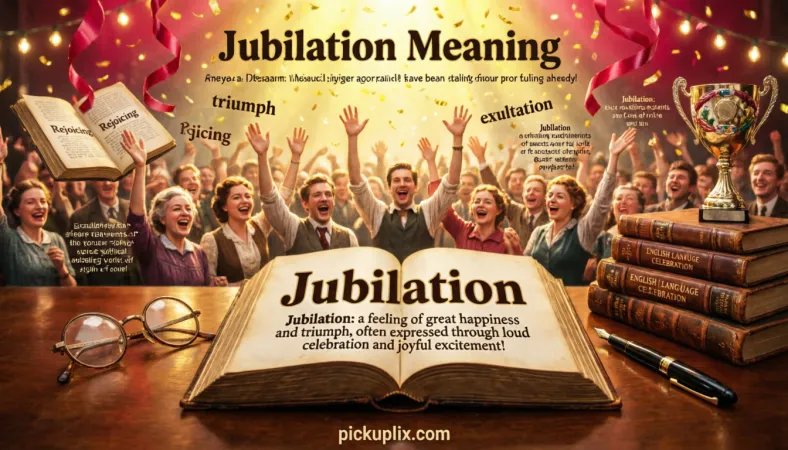
You’ve probably seen the word “jubilation” in a news headline about a championship win, a wedding announcement, or a big celebration, and wondered why writers reach for this word instead of just saying “happiness.” That’s because jubilation isn’t just ordinary joy, it’s the loud, overflowing kind of celebration that happens when something truly wonderful occurs.
Once you understand where the word comes from, you’ll notice it everywhere, from sports headlines to graduation speeches.
Quick Answer:
Jubilation means a feeling of great happiness and triumph, usually shown through joyful celebration.
It’s a formal, expressive word used to describe intense joy following success, victory, or a major achievement.
What Does Jubilation Mean?
Jubilation is a noun that describes a state of joyful celebration, typically tied to triumph, success, or a major positive event. It’s more intense and expressive than everyday happiness, it implies visible excitement, cheering, or celebration shared with others.
The word comes from the Latin “jubilare,” meaning “to shout for joy,” which is also related to the word “jubilee,” used to describe major milestone celebrations, like a 25th or 50th anniversary.
Example Sentence: The stadium erupted in jubilation as the final whistle blew and the underdog team secured the championship win.
In short: Jubilation = Triumph + Celebration = Overflowing Joy.
Jubilation vs. Similar Emotional Words
Jubilation is often grouped with other “happy” words, but each carries a different intensity and context.
- Happiness — A general, everyday positive feeling
- Joy — A deeper, more heartfelt form of happiness
- Excitement — Energetic anticipation or thrill, not always tied to success
- Jubilation — Intense, celebratory joy specifically tied to triumph, victory, or achievement
While happiness can describe a quiet, personal feeling, jubilation almost always implies a shared, visible, and enthusiastic celebration.
Despondency Meaning: Definition, Origin, and Usage Explained
Where Is “Jubilation” Commonly Used?
- 📰 News and journalism — Common in headlines describing sports victories, election results, or major announcements
- 🏆 Sports commentary — Used to describe crowd or team reactions after a win
- 🎓 Formal speeches — Graduation ceremonies, award shows, and celebratory events
- ✍️ Literature and writing — Used to add emotional weight to celebratory scenes
This is a formal, descriptive word, more suited to writing, journalism, and speeches than everyday casual texting.
Examples of Jubilation Used in a Sentence
- Fans expressed pure jubilation after their team won the championship for the first time in decades.
- The village celebrated in jubilation when the long-awaited bridge was finally completed.
- Her family’s jubilation was obvious the moment she announced her acceptance into medical school.
- The streets filled with jubilation as the parade passed through downtown.
- His jubilation quickly turned to disbelief as he realized he had actually won the lottery.
- The team’s jubilation echoed through the stadium long after the final buzzer.
When to Use and When Not to Use “Jubilation”
✅ Use jubilation when:
- Writing about major victories, achievements, or celebrations
- Describing a crowd’s or group’s joyful reaction to good news
- Adding emotional depth to formal or journalistic writing
❌ Avoid using jubilation when:
- Describing small, everyday happy moments (a simpler word fits better)
- Texting casually with friends about minor good news
- The situation doesn’t involve celebration or triumph
| Context | Example Phrase | Why It Works |
| News Headline | “City erupts in jubilation after historic win.” | Bold, descriptive, and fitting for major events |
| Formal Writing | “Jubilation swept through the crowd.” | Adds emotional intensity |
| Casual Chat | “I’m so happy I passed my exam!” | Simpler and more natural for texting |
| Speech | “Today, we celebrate in jubilation.” | Fits ceremonial or formal tone |
Similar Words or Alternatives
| Word | Meaning | When to Use |
| Elation | Intense happiness or pride | Personal achievements |
| Exultation | Triumphant joy, often after success | Formal or literary writing |
| Euphoria | Overwhelming happiness, sometimes fleeting | Emotional or intense moments |
| Delight | Great pleasure or satisfaction | General positive situations |
| Glee | Playful, lighthearted joy | Casual or informal contexts |
| Triumph | Victory accompanied by joy | Competitive or achievement-based events |
Is Jubilation Only Used for Big Events?
While jubilation is most commonly associated with major victories or milestones, like championships, graduations, or historic announcements, it can technically describe any moment of intense, shared joy. However, using it for minor everyday happiness can sound overly dramatic, which is why it’s best saved for genuinely significant, celebratory moments rather than small wins or casual good news.
The History Behind the Word Jubilation
The roots of jubilation stretch back to ancient traditions of celebration. In biblical and historical texts, a “jubilee” referred to a special year, often marking fifty years, set aside for celebration, forgiveness of debts, and community joy. This connection explains why jubilation carries such a strong sense of collective, large-scale happiness rather than quiet personal contentment. Over centuries, the word evolved from describing formal, ceremonial celebrations to the broader, more expressive meaning it holds today, capturing any moment of triumphant, shared joy.
This historical weight is part of why jubilation feels so much bigger than ordinary happiness. It carries an echo of tradition, community celebration, and milestones worth remembering, which is exactly why writers and speakers reach for it during genuinely significant moments.
FAQs About Jubilation Meaning
What does jubilation mean?
Jubilation means a feeling of great happiness and triumph, usually expressed through joyful celebration, often after a major success or achievement.
Is jubilation a formal word?
Yes, it’s considered formal and expressive, commonly used in journalism, speeches, and writing rather than everyday casual conversation.
What’s the difference between jubilation and happiness?
Happiness is a general positive feeling, while jubilation specifically describes intense, celebratory joy tied to victory, success, or triumph.
Can jubilation be used for personal achievements?
Yes, it can describe personal milestones too, such as graduating, getting a dream job, or achieving a long-term goal, as long as the joy feels significant.
How do you use jubilation in a sentence?
You can use it to describe celebratory joy, for example: “The team celebrated their victory with jubilation that lasted long into the night.”
What is the adjective form of jubilation?
The adjective form is “jubilant,” used to describe a person or mood, as in “The jubilant crowd cheered as the winners were announced.”
Is jubilation related to the word “jubilee”?
Yes, both words share the same Latin root. A jubilee refers to a milestone celebration, often marking an anniversary, while jubilation describes the feeling of joyful triumph associated with such celebrations.
Conclusion
Jubilation is a powerful, vivid word for describing the kind of overflowing joy that comes with major victories, achievements, and celebrations. While everyday happiness might call for simpler words, jubilation captures that unmistakable feeling of triumph shared with others, whether it’s a stadium full of fans or a family celebrating good news. Learning expressive words like jubilation adds richness to both writing and conversation, especially when ordinary words just aren’t big enough for the moment.
Agatha Christie is a writer at Pickuplix.com, known for creating fun, clever, and confidence boosting pickup lines. She focuses on playful humor and relatable flirting that feels natural and easy. Her goal is to help readers spark conversations with a smile.