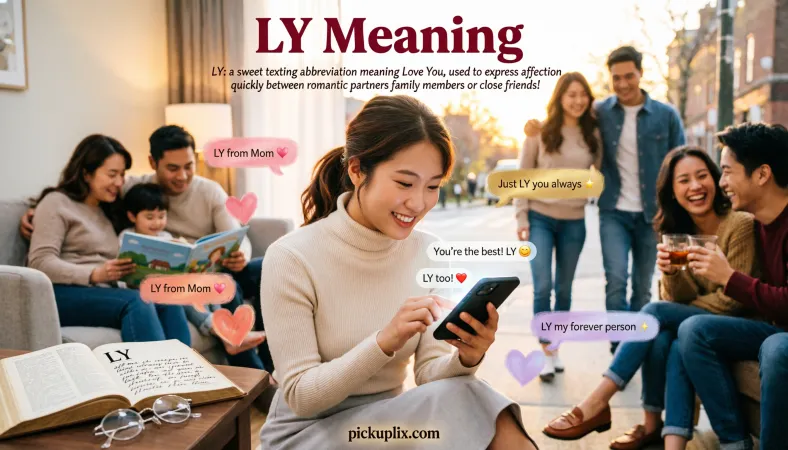
A text conversation with a close friend or partner wraps up, and right before the chat goes quiet, a simple “ly” pops up at the end.
It’s such a small abbreviation, but it carries a surprising amount of warmth packed into just two letters, and if you weren’t sure what it meant the first time you saw it, you’re definitely not alone.
Quick Answer:
LY means “Love You.” It’s a sweet, affectionate way of expressing love quickly, commonly used between close friends, family members, or romantic partners.
What Does LY Mean in Text?
LY stands for “Love You,” a shortened way of expressing affection at the end of a conversation or message. It’s commonly used to close out a text warmly, similar to saying “love you” out loud before hanging up a phone call.
Example Sentence: Heading to bed now, ly, talk tomorrow!
In short: LY = Love You = A Quick, Affectionate Sign-Off.
Where Is “LY” Commonly Used?
- 💬 Texting — One of the most common ways to end a conversation warmly
- 📱 Instagram and Snapchat DMs — Frequently used between close friends or partners
- 👨👩👧 Family group chats — Common when saying goodbye or ending a call
- 💕 Romantic relationships — Used often between partners as a quick, affectionate close
This phrase is casual and warm, perfect for close relationships, but it’s not typically used with acquaintances or in professional communication.
Examples of “LY” in Conversation
A: heading to bed, night! B: night, ly, sleep well 💕
A: talk to you tomorrow, have a good night B: you too, ly!
A: thanks for always being there for me B: always, ly so much
A: gotta go, class is starting B: okay, ly, good luck today
A: miss you already B: miss you too, ly!
When to Use and When Not to Use “LY”
✅ When to Use:
- Ending a text conversation with a close friend, family member, or partner
- Expressing quick affection casually
- Wrapping up a call or chat warmly
❌ When Not to Use:
- With acquaintances, coworkers, or people you’re not close with
- In formal or professional communication
- Early in a new relationship, where it might feel too intense too soon
| Context | Example Phrase | Why It Works |
| Close Friend Chat | “night, ly! 💕” | Casual and affectionate |
| Work Chat | “Have a great evening.” | Professional and appropriate |
| New Relationship | “Talk soon, have a good night!” | Warm without being too intense yet |
Similar Slang Words or Alternatives
| Slang | Meaning | When to Use |
| LYSM | Love You So Much | A more enthusiastic version of LY |
| LU | Love You (alternative spelling) | Nearly identical casual use |
| ILY | I Love You | Slightly more formal, spelled-out version |
| Love ya | Casual, spoken-style alternative | Everyday affectionate texting |
| XO | Hugs and kisses | Similar affectionate sign-off |
LY vs. ILY: What’s the Difference?
Both LY and ILY express love, but ILY (“I love you”) includes the full pronoun, making it feel slightly more direct and complete, while LY drops the “I” for an even quicker, more casual close. Many people use them interchangeably, though LY often feels a touch more offhand, perfect for a quick goodbye, while ILY can feel a little more intentional or heartfelt depending on the moment.
How “LY” Feels in Different Relationships
The warmth behind “ly” can shift slightly depending on who’s receiving it. Between family members, it often carries a comfortable, unconditional kind of affection, the kind exchanged out of habit and genuine closeness. Among close friends, it tends to feel more like an easy, natural expression of appreciation and platonic love. In romantic relationships, it usually carries a softer, more intimate tone, especially when used as a quiet, quick way to say “I love you” without making a big moment out of it.
Despite these subtle differences, the core meaning stays the same everywhere, a small, sincere way of letting someone know they’re cared about, even in the middle of a fast-paced text conversation.
FAQs About LY Meaning
What does LY mean in texting?
LY means “Love You,” a quick, affectionate way of expressing love, often used to close out a text conversation warmly.
Is LY the same as ILY?
They’re very similar, both express love, but ILY includes the full “I,” making it feel slightly more complete, while LY is a shorter, more casual version.
Who is LY typically used with?
It’s most commonly used between close friends, family members, or romantic partners, rather than acquaintances or professional contacts.
Is LY too intense for a new relationship?
It can feel that way early on, so it’s often better reserved for relationships where affection has already been clearly established.
Can LY be used platonically?
Yes, it’s commonly used between close friends and family members in a completely platonic, affectionate way, not just romantically.
Does capitalization change the meaning of LY?
Not significantly, whether typed as “ly” or “LY,” the meaning stays the same, though context and punctuation can add extra warmth or emphasis.
Is it okay to use LY with a new friend?
It depends on the friendship, some people use it casually and quickly with new friends they already feel close to, while others prefer to wait until the relationship feels more established.
Conclusion
Now that you know LY simply means “Love You,” those sweet little sign-offs at the end of your texts probably make even more sense. It’s a small, warm way to express affection without needing to type out a full sentence every time. Whether you’re texting a close friend, family member, or partner, LY remains one of the simplest and most heartfelt pieces of texting shorthand out there.
At the end of the day, it’s proof that even the shortest messages can carry real warmth. Two letters might not seem like much, but in the right context, they can say exactly what needs to be said

Pickuplix Team creates fun, clever pickup lines for every mood and occasion, along with clear, accurate word and slang meaning guides. From flirty icebreakers to breaking down the latest texting slang, we’re here to help you communicate with confidence.