
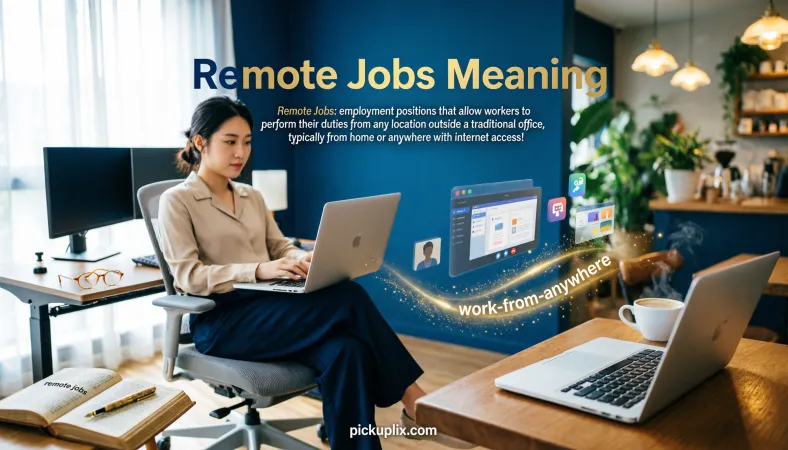
You’ve probably seen the phrase “remote job” everywhere on LinkedIn, in a friend’s Instagram bio, or in a job listing that says “100% Remote.”
But what does it actually mean, and how is it different from working from home or a hybrid job?
If you’ve ever felt unsure whether a remote job means you can work from anywhere or just from your house, you’re not alone.
Quick Answer:
A remote job means a job that you can do from any location outside a traditional office, using the internet, a phone, or a computer to complete your work and communicate with your team.
Remote jobs can be full-time, part-time, freelance, or contract-based.
What Does Remote Job Mean?
The word “remote” simply means “far away” or “not in a fixed physical location.” When it’s used with “job,” it describes work that doesn’t require you to be physically present in a company office.
A remote job typically means:
- You work from home, a co-working space, a café, or even while traveling
- You communicate with your team using tools like email, Slack, Zoom, or Google Meet
- Your output and results matter more than your physical location
- You may work in a different city or even a different country than your employer
Example Sentence: She landed a remote job as a content writer, so she now works from her apartment instead of commuting to an office every day.
In short: Remote Job = Work From Anywhere = No Fixed Office Location.
Remote Job vs Work From Home vs Hybrid
People often use these terms interchangeably, but they aren’t exactly the same.
| Term | Meaning | Flexibility |
| Remote Job | Work from any location, no office required | Highest flexibility |
| Work From Home | Work specifically from your house | Location-fixed to home |
| Hybrid Job | Split time between office and home/remote | Partial flexibility |
| On-Site Job | Work only from a company office | No flexibility |
A remote job is actually the broadest category. Working from home is just one way to do a remote job, but you could also do it from another city or country.
Types of Remote Jobs
Remote jobs come in several forms, depending on your schedule and employment status:
📌 Full-Time Remote Jobs Standard 40-hour work week, done entirely online.
📌 Part-Time Remote Jobs Fewer hours per week, still fully remote.
📌 Freelance Remote Work Project-based work for multiple clients, no long-term contract.
📌 Remote Contract Jobs Fixed-term agreements with a single company.
📌 Hybrid-Remote Jobs Mostly remote, with occasional in-person meetings or office visits.
Where Is “Remote Job” Commonly Used?
- 💼 Job listing platforms like LinkedIn, Indeed, and We Work Remotely
- 🖥️ Tech, marketing, writing, design, and customer support industries
- 📱 Freelancing platforms such as Upwork and Fiverr
- 🌍 Digital nomad and travel communities
It’s considered a professional and widely accepted term appropriate for resumes, job applications, and formal conversations.
Examples of “Remote Job” in Conversation
A: How’s the new job going? B: It’s great, it’s a fully remote job, so I get to work from my parents’ place this month.
A: Do you have to go to the office? B: No, it’s a remote job. I just need my laptop and Wi-Fi.
A: Is your company hiring remotely? B: Yes, they just posted a few remote job openings for developers.
A: What’s the difference between your job and a hybrid one? B: Mine’s fully remote hybrid means you still go to the office sometimes.
When to Use “Remote Job” (and When Not To)
✅ Use “remote job” when:
- Describing a position with no fixed office requirement
- Writing a resume, cover letter, or job application
- Talking about digital nomad or work-from-anywhere lifestyles
❌ Avoid using “remote job” when:
- The role actually requires occasional office visits (use “hybrid job” instead)
- The position is strictly limited to working from home only (use “work from home job”)
| Context | Example Phrase | Why It Works |
| Resume | “Seeking a remote job in digital marketing.” | Clear and professional |
| Casual Chat | “I got a remote job, no more commuting!” | Natural and conversational |
| Job Posting | “This is a fully remote position.” | Accurate description |
Similar Words or Alternatives
| Term | Meaning | When to Use |
| Work From Home (WFH) | Working specifically from your house | When location is fixed to home |
| Telecommute | Older/formal term for remote work | Formal or corporate writing |
| Digital Nomad | Someone who works remotely while traveling | Travel + work lifestyle context |
| Hybrid Job | Mix of office and remote work | Partial flexibility roles |
| Virtual Job | Work done entirely online | Similar to remote, less common term |
FAQs About Remote Jobs
What does a remote job mean?
A remote job means a job you can perform from any location outside a traditional office, using the internet and digital communication tools.
Is a remote job the same as work from home?
Not exactly. Work from home means working specifically from your house, while a remote job can be done from anywhere, including cafés, co-working spaces, or while traveling.
Can I get a remote job with no experience?
Yes, many entry-level remote jobs exist in fields like customer support, data entry, and content writing, though competition can be high.
Do remote jobs pay less than office jobs?
Not necessarily. Pay depends on the role, industry, and company many remote jobs offer the same or even better pay than on-site positions.
What skills do I need for a remote job?
Common skills include self-discipline, communication, time management, and familiarity with tools like Zoom, Slack, and Google Workspace.
Are remote jobs only in tech?
No. Remote jobs exist in marketing, writing, design, customer service, teaching, HR, and many other industries.
Conclusion
Understanding the meaning of a remote job is simple once you break it down: it’s any job that lets you work from outside a traditional office, using the internet to stay connected with your team. Whether it’s full-time, freelance, or contract-based, a remote job offers flexibility that traditional office jobs don’t. Knowing the difference between remote, hybrid, and work-from-home roles can also help you search for the right opportunities and describe your own job accurately.

Mark Twain is a writer at Pickuplix.com, creating witty and fun pickup lines to help readers flirt with confidence and make people laugh.